
Captain
William Kidd
Scottish Privateer
The Man History
Misnamed a Pirate
c. 1645 – May 23, 1701 · Active: 1696–1699 · Region: Indian Ocean, Caribbean, Atlantic
AT A GLANCE
Born: c. 1645, Dundee or Greenock, Scotland
Died: May 23, 1701 Execution Dock, Wapping, London
Nationality: Scottish (based in New York City)
Active: 1696–1699 (Indian Ocean voyage)
Primary vessel: Adventure Galley (34 guns, 284 tons)
Secondary vessel: Quedagh Merchant (seized prize, renamed Adventure Prize)
Commission: Legal privateering commission King William III, 1695
Backers: Earl of Bellomont, Lord Shrewsbury, Lord Romney, Lord Orford, Sir John Somers
Convicted of: Piracy and murder of gunner William Moore
Historical verdict: Almost certainly not guilty as charged key evidence suppressed
THE MYTH
Captain Kidd. The name alone conjures treasure maps, buried gold, a skull-and-crossbones flag, and the archetypal pirate captain of a hundred stories, films, and novels.
Daniel Defoe fictionalized him. Robert Louis Stevenson borrowed from his legend. The popular imagination turned William Kidd into the definitive pirate cunning, ruthless, the embodiment of Golden Age lawlessness.
Almost none of it is true.
"The treasure maps are fiction. The buried gold is fiction.
The iconic pirate captain of a hundred stories fiction.
The real William Kidd was the man his backers needed him to be."
The real William Kidd was a Scottish sea captain, a New York property owner, a husband and father, a church-going member of his community, and a man who spent most of his career operating as a legitimate privateer and merchant mariner. He was commissioned by the English Crown to hunt pirates. He ended his life at the end of a rope that broke on the first attempt hanged for crimes that the evidence, had it been allowed to surface, might well have disproved.
This is his real story.
EARLY LIFE AND LEGITIMATE CAREER
William Kidd was born around 1645, most likely in Dundee or Greenock, Scotland. The details of his early life are sparse a recurring theme for a man whose historical record has been so thoroughly shaped by his enemies.
By the 1680s he was an established sea captain operating in the Caribbean. He served with a group of buccaneers against the French in the West Indies, and in 1689 his crew mutinied and took his ship leaving him stranded in Nevis. Characteristically, Kidd recovered: the colonial government of Nevis rewarded him with a new vessel for his services against the French, which he named the Blessed William.
He sailed to New York, where he settled, married Sarah Bradley Cox Oort a wealthy widow, twice over and became a respected figure in colonial society. He owned property in New York City. He contributed to the building of Trinity Church on Wall Street. He was, by any measure, a man of standing.
Throughout the early 1690s he continued working as a privateer and merchant captain, earning a reputation as a competent and reliable commander. He was not a man drifting toward piracy. He was a man building a life.
THE COMMISSION 1695
In 1695, Richard Coote, Earl of Bellomont the newly appointed Governor of New England was looking for a solution to a specific problem: the Indian Ocean was overrun with pirates preying on Mughal shipping and East India Company vessels, and the political fallout was threatening England's commercial interests in India.
The solution, someone decided, was to commission a private captain to hunt the pirates funded not by the Crown directly but by a syndicate of wealthy backers who would share in any prizes taken.
The backers assembled were not minor figures. They included four members of the English government Lord Shrewsbury, Lord Romney, Lord Orford, and Sir John Somers, the Lord Chancellor along with the Earl of Bellomont himself. These were men at the center of English political power.
They chose William Kidd.
"His commission was legal. His backers were some of the most powerful men in England.
When the voyage went wrong, they had every reason to make Kidd the problem and themselves the innocent victims."
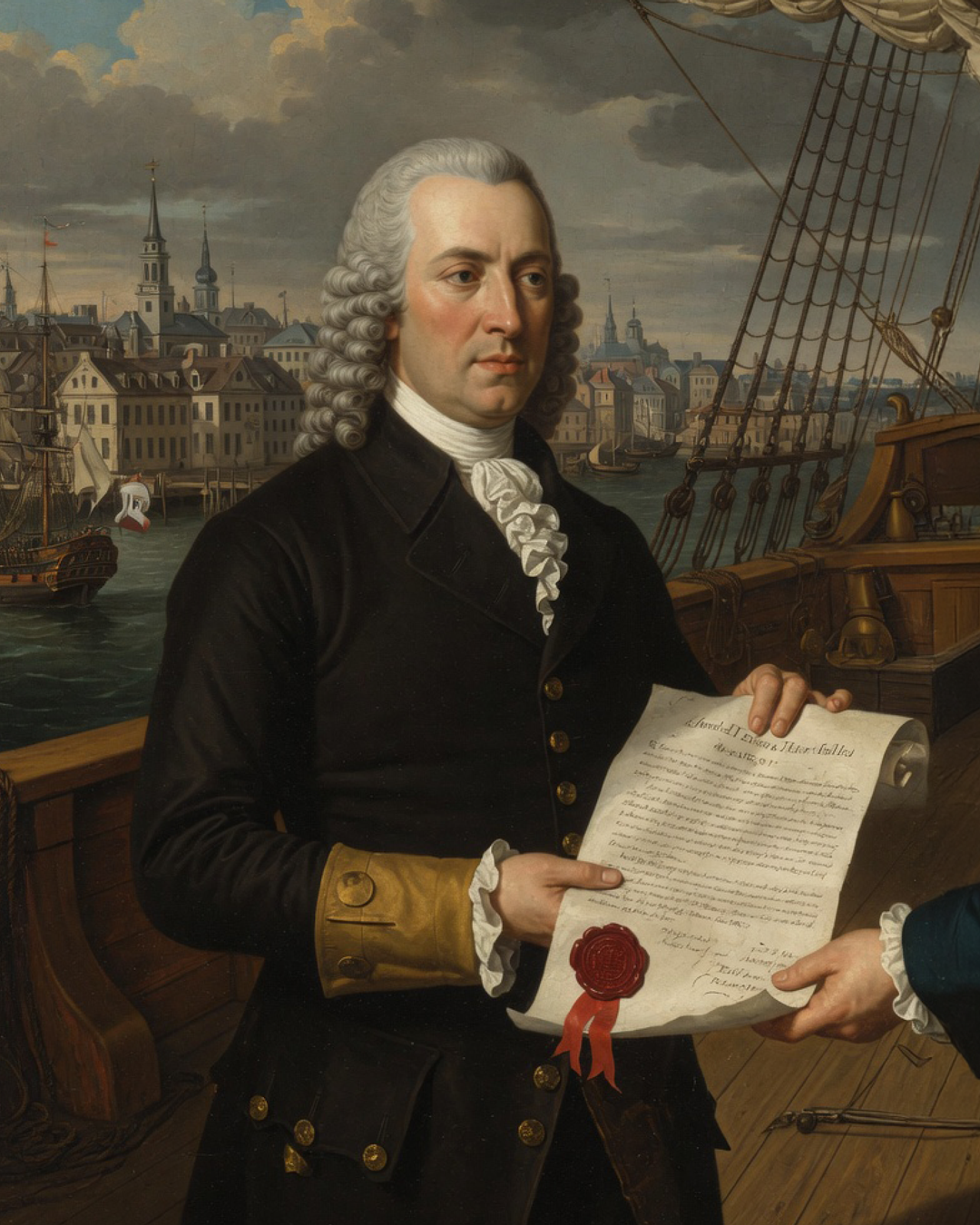
Kidd was given two commissions: one to act against pirates under the 1694 Act for the More Effectual Suppression of Piracy, and a second extraordinarily as a royal privateer against French shipping, since England and France were at war. He was provided with a new ship, the Adventure Galley, a 34-gun vessel of 284 tons, and he recruited a crew in New York and London.
The crew was the first problem. Many of the men available were former pirates themselves, operating under the King's Pardon men who had accepted amnesty and were theoretically going straight. Kidd took them because he had few alternatives. The commission required him to be at sea quickly.
The Adventure Galley departed New York in September 1696. William Kidd was fifty years old, legally commissioned, politically backed, and sailing toward the worst three years of his life.

THE VOYAGE 1696 TO 1699
The Indian Ocean
The voyage to the Indian Ocean went badly from the start. The Adventure Galley was already showing signs of structural weakness. Disease swept through the crew, killing dozens. Kidd rounded the Cape of Good Hope and made for Madagascar, then pushed north toward the Red Sea mouth the established hunting ground for pirates preying on Mughal convoys.
Here Kidd made a decision that would later be used against him: he approached the Mughal convoy at Mocha in August 1697. But he pulled back before attacking either because he had second thoughts or because an East India Company escort vessel was present. The convoy passed unmolested.
His crew was becoming dangerous. Men who had signed on expecting prizes were getting nothing. The Adventure Galley was deteriorating. Desertion was a constant threat.
The Death of William Moore
On October 30, 1697, ship's gunner William Moore challenged Kidd openly on deck calling him a lousy dog and accusing him of ruining them all. Kidd responded by striking Moore on the head with an iron-bound bucket. Moore died the following day.
This was the act for which Kidd would ultimately be convicted of murder. At trial, the prosecution argued it was deliberate killing. Kidd argued it was a response to a mutinous challenge in the heat of the moment that Moore was inciting the crew against him. By the standards of the era, a captain striking a mutinous crewman was not unusual. The outcome, however, was fatal.
The Quedagh Merchant
In January 1698, Kidd took the prize that sealed his fate: the Quedagh Merchant, a large Armenian-owned vessel carrying goods largely owned by Mughal officials and trading under French passes documents issued by the French East India Company authorising the ship to trade under French protection.
This was the critical legal point. Kidd's privateering commission authorised him to take French vessels. If the Quedagh Merchant was operating under French passes, the seizure was arguably legal. Kidd kept the French passes. He renamed the vessel Adventure Prize and sailed her toward the Caribbean.
He never made it home clean.
THE BETRAYAL
By the time Kidd reached the Caribbean in 1699, everything had changed politically. The backers in London were under attack. The Tory opposition was using the privateering commission and the names of the Whig lords who had backed it as a political weapon. The Earl of Bellomont, now Governor of Massachusetts, needed to demonstrate he had no connection to piracy.
Kidd was the solution. He was the man they sent. He could be the man they blamed.
"The key evidence in his favour disappeared before trial.
The French passes the documents that proved his seizures were legal were not produced in his defence.
They were found misfiled in the Public Record Office in 1911."
Kidd, apparently still believing his backers would protect him, sailed to Boston in July 1699 to meet with Bellomont. He was arrested immediately. His ship and cargo were seized. He was sent to London in chains.
The Adventure Prize the Quedagh Merchant was left in the Caribbean under a skeleton crew. While Kidd was imprisoned in London, the crew sold her cargo and the ship herself was stripped and burned. The material evidence of what Kidd had actually taken, and under what circumstances, was destroyed.
The Missing French Passes
Kidd had two French passes taken from the Quedagh Merchant and a second vessel, the Rouparelle which were the foundation of his legal defense. If the ships were operating under French passes, his seizures were lawful under his commission.
The passes were in Bellomont's possession. They were not produced at trial. Kidd's lawyers requested them. They were not provided.
For 210 years the passes were missing. In 1911, researchers found them in the Public Record Office in London misfiled among unrelated documents. They had been there all along.
Whether they were deliberately suppressed or genuinely lost is a question historians continue to debate. What is not debated is that their absence at trial removed Kidd's primary defense.
THE TRIAL AND EXECUTION 1701
William Kidd was tried at the Old Bailey in May 1701. The trial lasted two days.
He was charged with the murder of William Moore and five counts of piracy. He was convicted on all charges.
His crew members who might have testified in his favour had been offered pardons in exchange for testimony against him. The French passes were absent. His powerful backers were silent. The political climate demanded a pirate, and Kidd was the pirate available.
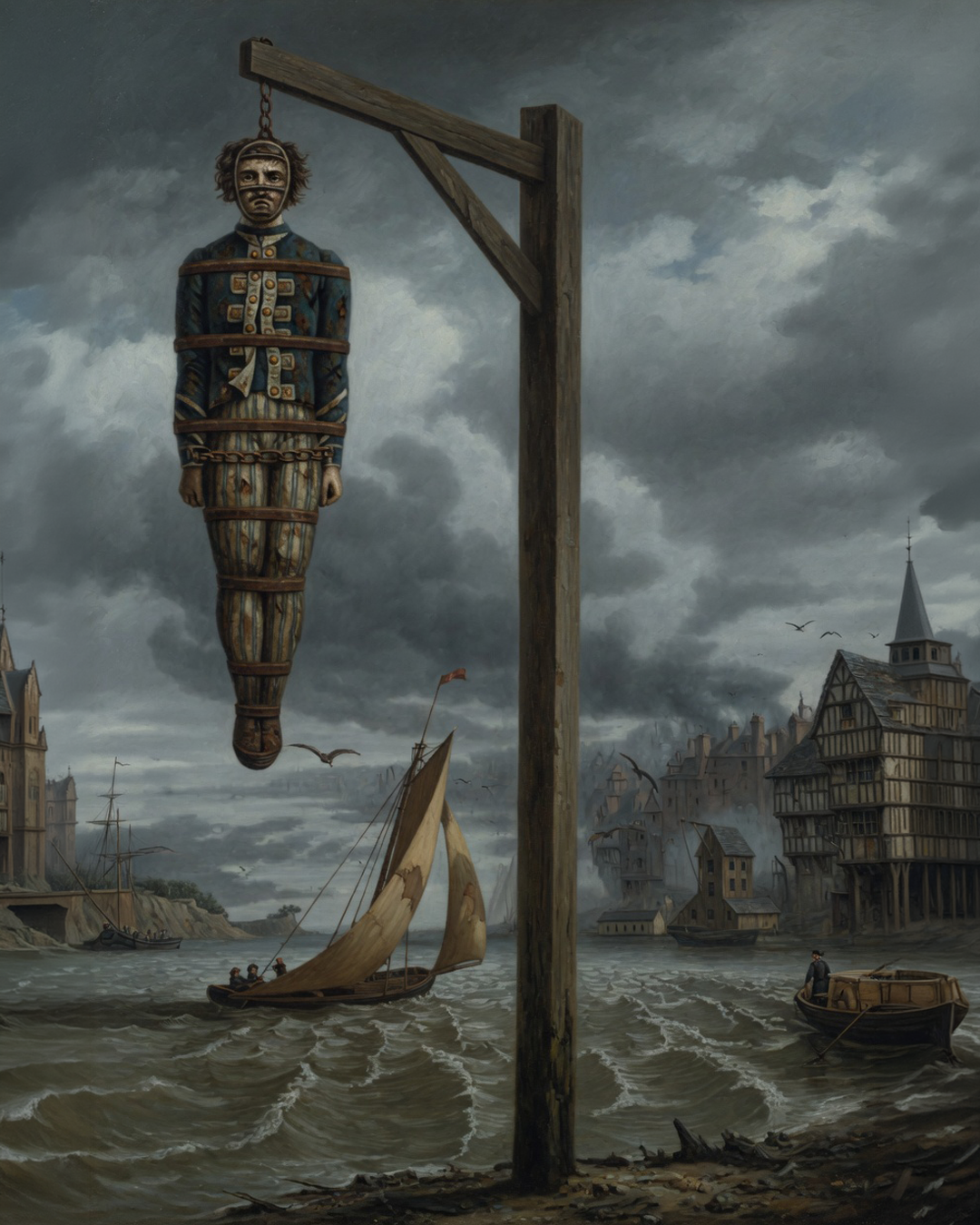
"He was hanged at Execution Dock, Wapping, on May 23, 1701.
The rope broke on the first attempt. He was hanged again."
After execution, his body was coated in tar and suspended in a gibbet over the Thames at Tilbury Point. It hung there for three years a visible warning to every sailor who passed upriver into London. The Admiralty wanted the lesson seen.
He was fifty-six years old. His wife Sarah and their two daughters survived him in New York.
THE BURIED TREASURE MYTH AND REALITY
The legend of Captain Kidd's buried treasure began almost immediately after his arrest and has never entirely died. Before his execution, Kidd reportedly offered to lead authorities to a vast buried treasure if his life was spared. The offer was refused possibly because those in power didn't believe him, possibly because they did and wanted to find it themselves.
Various amounts of treasure were recovered from Gardiner's Island, New York where Kidd had made deposits before sailing to Boston. Some gold, silver, and jewels were recovered and used as evidence at trial.
But the legend insisted there was more. Treasure maps appeared, linked to Kidd's name. Expeditions were launched. Islands were dug up. Nothing of significance was ever found.
In 2015, a silver bar was recovered from the waters off Sainte-Marie Island, Madagascar initially reported as being from the Quedagh Merchant. The claim was later disputed by archaeologists who questioned the attribution. The treasure legend continues to attract believers.
The honest historical assessment: whatever Kidd's total plunder amounted to, it was not the legendary fortune the myth requires. He was a privateer who took a handful of prizes over three years and spent most of that time battling a deteriorating ship, a mutinous crew, and catastrophic bad luck.
HISTORICAL VERDICT WAS KIDD A PIRATE?
The scholarly consensus, developed over decades of archival research, is cautious but leans toward Kidd's innocence on the most serious charges.
The French passes had they been produced at trial would have provided a credible legal defense for the taking of the Quedagh Merchant, the central piracy charge. Whether a sympathetic judge would have accepted the defense is unknowable. That they were not produced at all meant the defense was never tested.
The murder of William Moore is more ambiguous. The act itself is not disputed Kidd struck Moore with a bucket and Moore died. Whether it constituted murder or a captain's response to mutiny depended entirely on how the jury interpreted Kidd's intent and the circumstances on deck that day. The jury took little time to convict.
What is clear is that Kidd was politically expendable. His backers needed distance from the commission. The government needed a pirate to hang at a moment when piracy in the Indian Ocean was a diplomatic crisis. Kidd was available, he had taken prizes, and the evidence that might have complicated the picture was not in the courtroom.
"Kidd was almost certainly not the pirate history made him.
He was the man his backers needed him to be and the legal system of 1701 gave them exactly what they required."
He was not innocent of everything. The death of William Moore was real. Some of his decisions at sea were questionable. A captain with a cleaner record, better legal representation, and powerful friends who didn't need a scapegoat might have survived the same charges.
Kidd had none of those things by the time he reached the Old Bailey.
LEGACY AND INFLUENCE
Captain Kidd's legacy is one of the strangest in the history of piracy: a man executed for crimes he likely didn't commit, who became more famous after his death than he ever was in life, and whose fictional persona bears almost no resemblance to the real person.
Daniel Defoe who wrote extensively about pirates and is believed by some scholars to be the author of A General History of the Pyrates drew on Kidd's story in his writings. The legend of buried treasure, the dramatic trial, the theatrical execution made Kidd perfect material for the popular imagination.
Robert Louis Stevenson acknowledged Kidd as an influence on Treasure Island. The name alone Captain Kidd carried exactly the right combination of menace and mystery.
In maritime legal history, the Kidd case is studied as an early example of how political pressure can corrupt criminal proceedings, how the suppression of evidence can determine an outcome, and how the colonial legal system of the early 18th century was ill-equipped to handle the complexity of privateering law.
His Adventure Galley has never been definitively located, though several searches have been conducted in the waters around Madagascar and the Caribbean.
The Quedagh Merchant or what remained of her was located in 2007 in shallow water off the Dominican Republic by a team from Indiana University. She had been stripped and burned, as history recorded. Her hull remains are a protected archaeological site.
SEAFARER REPUBLIC THE CAPTAIN KIDD SERIES
The Seafarer Republic Captain Kidd design is part of the Captain Series a collection built on real historical figures, real voyages, and real stories. Not the myths. Not the Hollywood versions.
The Kidd design carries his portrait in the style of the series drawn from period research and the historical record rather than the fictional pirate captain the legend created. The dates on the garment 1696 to 1699 mark the Adventure Galley voyage: three years that destroyed a man and created a myth.
We think it matters that you know the difference between the legend and the man.
The legend is entertaining. The man's story is more interesting and considerably more damning of the system that killed him.
Wear the history. Know the story.
@seafarerrepublic

FURTHER READING & SOURCES
Zacks, Richard. The Pirate Hunter: The True Story of Captain Kidd. New York: Hyperion, 2002.
Cordingly, David. Under the Black Flag: The Romance and the Reality of Life Among the Pirates. New York: Random House, 1995.
Ritchie, Robert C. Captain Kidd and the War Against the Pirates. Cambridge: Harvard University Press, 1986.
Jameson, J. Franklin, ed. Privateering and Piracy in the Colonial Period: Illustrative Documents. New York: Macmillan, 1923.
The French Passes Public Record Office, London (rediscovered 1911, now held at The National Archives, Kew).
The Quedagh Merchant archaeological site Indiana University / RPM Nautical Foundation, 2007.
© Seafarer Republic · seafarerrepublic.com · All historical content researched and written for the Seafarer Republic Captain Series.